May 8, 2011

Jack Vance - Planet of adventure - Tschai series

Jack Vance was born John Holbrook Vance in August 28, 1916 in San Francisco and was a genius as a sci-fi writer. Perhaps his writing style was not cultured and subtle, but that was more than compensated with a prodigious and fertile imagination, from which emerged complex , dangerous, exciting and varied worlds, full of adventures and challenges and of heroes willing to overcome obstacles and enjoy surprises. Books that will make you dream with open eyes fixed on its pages, refusing to sleep: ten more minutes, ten more pages, only until the end of this chapter, it's still not to late, I can read a bit more...

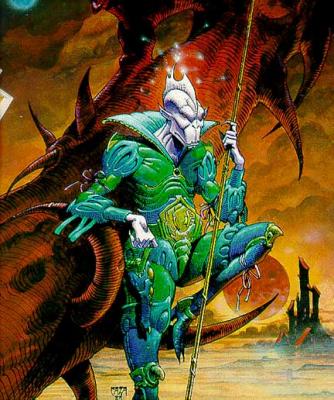
Dirdir


Planet of Adventure is the name given to a series of four science fiction novels by Jack Vance, which relate the adventures of Adam Reith, the sole survivor of an Earth ship investigating a signal from the distant planet Tschai.
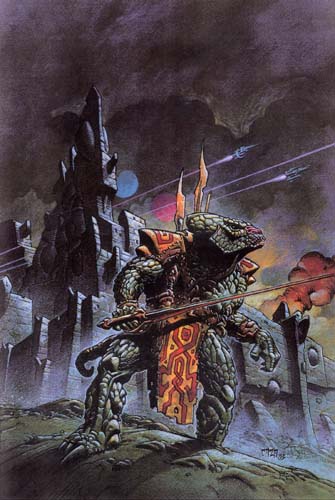
Chasch


 In order, the books are:
Wankh


 Plot
Adam Reith is sent with another scout in a small ship to investigate a distress signal sent centuries before from the previously unknown planet. The mother ship is destroyed and the rest of the crew killed in a surprise missile attack. The two survivors are forced to set down on Tschai and soon enough, Reith is alone. The four books describe the attempts of a man of singularly strong will and resource to return to Earth. He overcomes the obstacles of dealing with four different alien races and various human groups in his efforts. In the process, he profoundly disrupts several of the societies, human and alien, with which he is forced to deal.
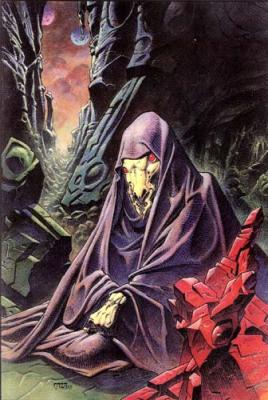
Pnume
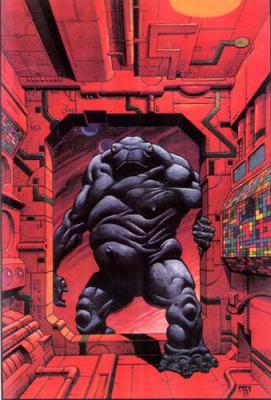
"Barlowe's Guide to Extraterrestrials

Reith acquires two faithful human companions in the course of his travels: Traz Onmale, the dour, proud boy-chieftain of a nomad race obsessed with emblems, and the renegade Dirdirman, Ankhe at Afram Anacho, loquacious, fastidious and flamboyant. (Vance has said that the novels were commissioned as a juvenile series, which was why he included Traz; but the action is no less ‘adult’ than in his other works.) The third novel also introduces a villain in the enormously fat, petulant, pedophilic, shamelessly avaricious contractor Aila Woudiver.
The vast teeming planet with its clashing civilizations and multifarious cultures affects Reith to the point that he realizes that if he succeeds in returning to Earth, his life will seem dull and colourless in comparison.

Jack and Norma Vance
If you want to read a great article about Jack Vance, visit this one in More Red Ink

May 7, 2011

Justin Cronin: The Passage


A scientist leading an expedition deep in the jungle, discovers a miracle substance that may allow to increase the life expectancy of mankind and destroy most diseases. At least that is what he believes but time proves him wrong and no man comes out alive from the expedition. Those who survive are no longer human beings.

In a top secret U.S. government facilities the unthinkable happens: a security flaw allows the escape of monstrous beings that were the subject of a military experiment with a virus. In an incredibly short time, they unleash chaos and destruction in its wake.


Not far from there, Amy, an orphan girl, barely six years old, begins a treacherous journey. Amy is a very special girl and that is well known by the bloodthirsty beings chasing here, and so do those who have ordered the FBI agent Brad Wolgast you to get her at all costs.

But Wolgast disobeys his orders and instead, decides to protect Amy. Knowing that she is the key to stopping the horror that has gripped the planet. As the Earth as we know it is approaching its own end at a terrific speed, Amy and Wolgast begin their peculiar odyssey through a world transformed by man's darkest dreams, waiting for that moment they can end what should never have happened.


People affected by the virus turn into vampire-like creatures and children have to be evacuated from the cities, carried to fortified settlements, colonies, where they can be protected.

Born to be a bestseller, people complain about its size, more than 1000 pages. For me, 1000 pages are O.K., no objection at all provided they are good or even only funny such as these are. Low pace at times, specially in the middle.


As read in libro-génica:

"The Passage"is a grand narrative full of characters very finely drawn that as it progresses, becomes a discussion between several voices on human society, their dialogue ranging between individualism and solidarity. Also, it is seen as a study of human behavior to hostile conditions: an internal struggle that almost all the book's characters manage to beat - their road punctured by difficult choices and the ongoing duel between the magnet of madness and the strength of survival.

May 6, 2011

Hal Clement - Mission of Gravity

Mesklin is a very large and very dense planet. Its surface gravity varies greatly from 3g at the equator to 700g at the poles.

 
The oceans are liquid methane and  snow is frozen
ammonia. Under these nightmarish conditions live mesklinitas, who have developed a culture and a society perfectly suited to the conditions of their environment. Barlemann, a bold mesklinita sailor agrees to undertake an impossible journey to save an expensive Earth probe broken on the pole of the planet. For mesklinitas the trip is a wonderful opportunity to discover science and progress in the path of knowledge, and this is the driving force that guides them through many adventures motivated by working and negociating with humans.


This is "hard" science-fiction, of the kind that pays special attention to scientific and technical details of the story. The most characteristic aspect of this book is the clarity of its approach.  Clement introduces his characters without further preamble, and in fact does not even bother to explain how humans managed to arrive to Mesklin and there's no hesitation, no doubt or speculation. The mesklinitas are remarkably intelligent, and therefore smart and cunning, basic characteristics of any self-respecting adventurer. In that sense, they can seem too human but that's part of the clarity of approach. 

Masterpiece and classic.  


Harry Clement Stubbs (May 30, 1922 – October 29, 2003) better known by the pen name Hal Clement, was an American science fiction writer and a leader of the hard science fiction subgenre. He went to Harvard, graduating with a B.S. in astronomy in 1943. His further educational background includes an M.Ed. (Boston University 1946) and M.S. in chemistry (Simmons College 1963).

During World War II Clement was a pilot and copilot of a B-24 Liberator and flew 35 combat missions over Europe with the 8th Air Force. After the war, he served in the United States Air Force Reserve, and retired with the rank of colonel. He taught chemistry and astronomy for many years at Milton Academy in Milton, Massachusetts.

He also painted astronomically oriented artworks under the name George Richard.

He created (below from wikipedia) a number of notably unusual fictional planets as settings for his works. They include:
  • Abyormen – A planet circling a dwarf star (Theer), which in turn circles a blue giant. This produces a hot and a cold season, each of 65 years' duration. The native intelligent life forms undergo a seasonal mass death. From Cycle of Fire.
  • Dhrawn – A high-gravity world settled by Mesklinites in Star Light.
  • Habranha - A planet that is tidally locked with its sun, such that the far side is a mix of solid CO2, solid methane, and ice, and the other side completely ocean, in Fossil.
  • Hekla – An ice-age planet in Cold Front (short story, Astounding July 1946).
  • Kaihapa – An uninhabited ocean planet, twin of Kainui, in Noise.
  • Kainui – An inhabited ocean planet in Noise.
  • Mesklin — A planet with ultra-high gravity (up to 700 g) in Mission of Gravity. Clement later corrected his model of Mesklin and determined that the maximum surface gravity would be "only 250 gravities".
  • Sarr – An extremely hot planet with an atmosphere of gaseous sulphur ('air') and liquid copper sulphate ('water') in Iceworld
  • Tenebra – A high-gravity world with a corrosive atmosphere in Close to Critical.
  • Enigma 88 - A small planet near η Carinae in Still River. The interior of the object is honeycombed with caves, due to evaporation of accreted ice-rich planetoids. Unusually for Clement, Enigma's structure is not fully consistent with the laws of physics.

May 5, 2011

John Christopher - The Dead of the Grass (No Blade of Grass)


 This is a 1956 post-apocalyptic science fiction novel written by the British author Samuel Youd under the pen name of John Christopher and deals with the concept of a virus that kills off all forms of grass.

A viral strain has attacked rice crops in East Asia causing massive famine; soon a mutation appears which infects the staple crops of West Asia and Europe such as wheat and barley, threatening a famine engulfing the whole of the Old World, while Australasia and the Americas attempt to impose rigorous quarantine to exclude the virus.

The novel follows the struggles of architect John Custance and his friend, civil servant Roger Buckley as, along with their families, they make their way across an England which is rapidly descending into anarchy, hoping to reach the safety of John's brother's potato farm in an isolated Westmorland valley. Picking up a travelling companion in a gun shop owner named Pirrie, they find they must sacrifice many of their morals in order to stay alive. At one point, when their food supply runs out, they kill an innocent family simply to take their bread. The protagonist justifies this with the belief that "it was them or us."


"John Christopher" is a pseudonym for Samuel Youd, born in Lancashire, in 1922. More information about him here.

Fitting into the line of sci-fi catastrophic mid-century English literature, Christopher's accomplishments are respectable but they pale beside those of the two great representatives of this school, John Wyndham and JG Ballard. However, the death of the grass is a valuable and interesting novel, although perhaps not worth the excessive credit given to it by David Pringle when he includes it among the best and outstanding works of sf in his famous monograph (which, yes, you've guessed correctly, I'm following in order to select my readings these days).

May 4, 2011

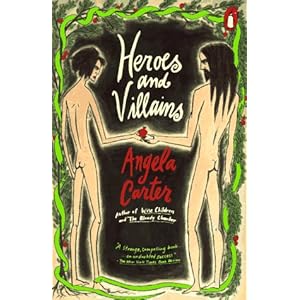
Angela Carter: Heroes and Villains (1970)

 
After a nuclear war, there are three surviving societies: the Professors, an elite group of survivors who form scattered enclaves of civilization sustained by farming; the Barbarians, nomads who have survived outside the bunkers, raiding the Professors' villages for supplies and food; and the Out People, mutants who have been mutilated by the radiation, inhabiting the ruins. The protagonist, Marianne, is a Professor's daughter. As a child, she witnesses an attack on her village during which a young Barbarian kills her brother. She grows more and more bored with life among the Professors, so at the age of sixteen, following her father's death, she willingly helps a Barbarian warrior during another attack and runs away with him to his tribe. After her attempted escape and rape by her dark companion Jewel, she is forced to marry him and discovers that he is the one who murdered her brother. Their relationship is ambiguous--erotic and antagonistic--but eventually, when Marianne gets pregnant, she allies herself with Jewel to overthrow the power of Donally, the renegade Professor and the tribe's shaman as well as Jewel's tutor, who introduced the Barbarians to the power of myth and ritual. When Jewel is killed in an ambush, Marianne decides to become a new leader of the Barbarians, a Tiger Lady determined to "rule them with a rod of iron"   (This synopsis and a deep and philosophical analysis that I can't fully understand, you can find in Highbeam)


I personally don't find this post apocalyptic world convincing, perhaps the book has not aged well. I didn't like it, I find it simple, needlessly brutal and Manichean, and won't spend more time with it. 

Please, if you liked it, tell me why because I admit that sometimes I'm unfair to certain books that I've read at the wrong time in my life, and knowing they are worthwile, I can retake them in another time and be able then to acknowledge the merit and grace in them. 


May 3, 2011

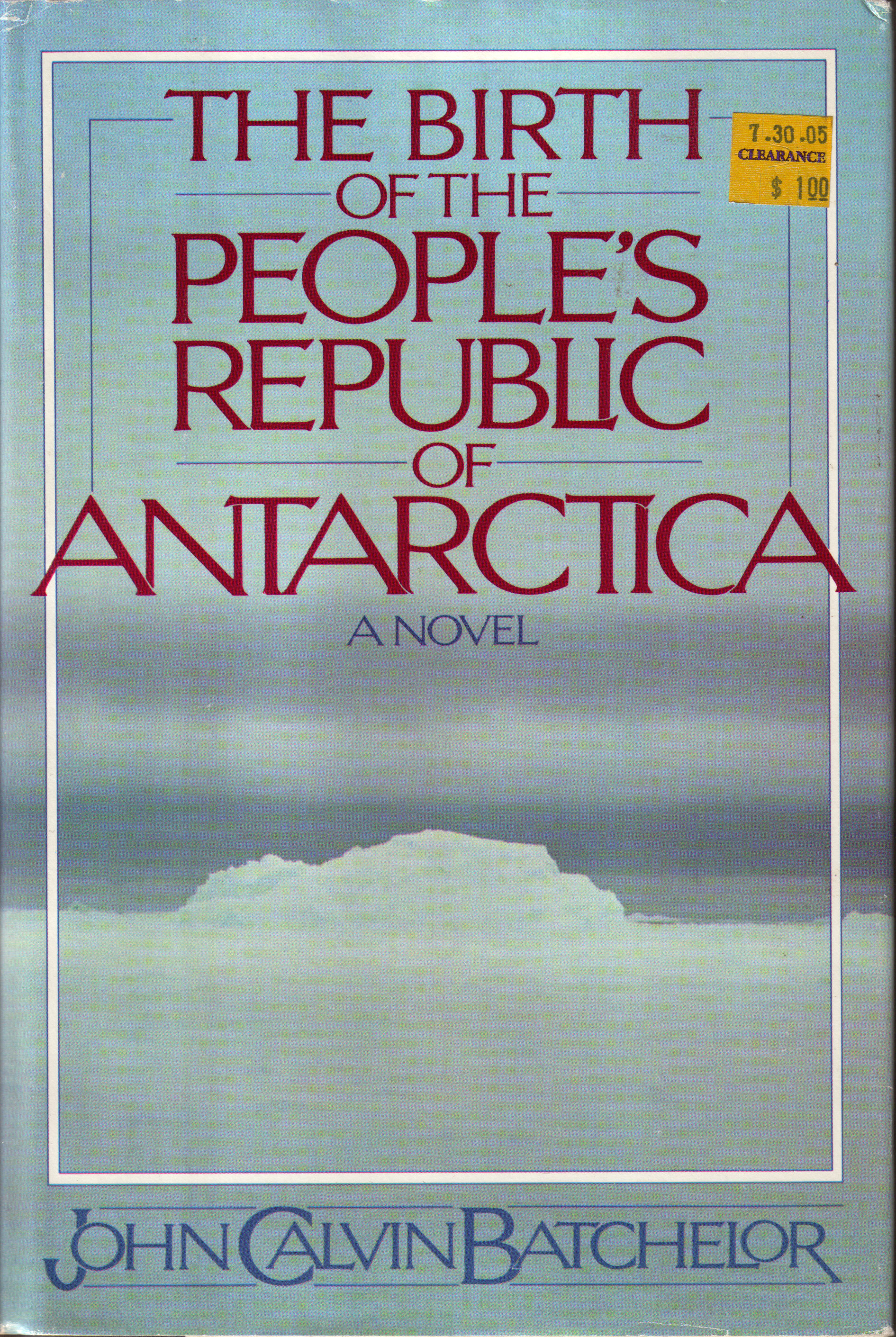
John Calvin Batchelor: The birth of the People's Republic of Antarctica


 The book tells the strange story of Grim Fiddle, born in Sweden, and of his father, Peregrine, an American who escaped the U.S. war in Vietnam and is illegal in Sweden. Grim grows up around Peregrine's friends who take care of him, but things in Sweden get complicated, because Peregrine is imprisoned and becomes the symbol of a xenophobic nationalist revolt led by Mord Fiddle, the grandfather of Grim. Eventually, Grim, his grandfather and his friends are aimed at a sea voyage in the midst of a cruel, even mysterious war that shakes Europe and the adventure takes them to the Falkland Islands, then to South Georgia and the Antarctic Peninsula finally ...

Told in first person by an old Grim who recounts his memories, and talks about war crimes he committed, the novel creates an atmosphere of condemnation and guilt, and is full of philosophical reflections on human nature, the relationship between the powerful nations, poor nations and the relations of war. 

Classification? Future social history sci-fi, maybe. with the emphasison the sociology of a world involved in a war that is almost a worldwide phenomenon. "Norse saga" or "epic" could also be applicable categorizations. 


There are two distinct parts. In the first, which occupies almost all the book, deals with the long drift to the ice and the exile of Grim Fiddle. In the second part, it suggests vaguely historical events in the background. Western governments, concerned about the unstoppable wave of refugees and the problems that can cause, organize what is called the Cross of Ice, which is responsible to set up camps for resettlement in the Antarctic Circle which are reality nothing more than concentration camps where refugees are expected to stay away from civilization.

John Calvin Batchelor Show at the radio


 Surprisingly, the People's Republic of Antarctica has been finally founded in Aug. 18th of 2010 by the citizens of Antarctica (the Mary Byrd Land section). Although the country claims land amounting to an area greater than that of most nations, it is not recognised by other countries as of yet, however the United Nations has been notified of it's declaration of status. The Nation has no permanent population, and can thus be considered a micronation.


May 2, 2011

Algis Budrys - Labyrinth of the moon (or Rogue Moon).


 The U.S. Government has discovered an alien artifact on the moon. It’s a structure about 100 by 20 meters, and it has a door. At the beginning of the story the government had put maybe hundreds of men through that door, and not one of them had made it out alive. The purpose of the structure seemed to be to kill whatever went into it. It was a labyrinth that would kill those who did not absolutely stick not only to the path, but also to body contortions as they moved through. Along comes Connington, a HR director for the project. He convinces Hawkes, the project manager that what he really needs is a crazy man who doesn't care about death, and delivers him Barker, a suicidal narcissist with a flair for daring-do. h get the job done they do, but in probably the biggest let down in the history of the genre. Barker makes his way gradually through the artifact over the course of months, dying on the Moon who knows how many times, but never going insane or dying on Earth, until one day he announces that he is at the end. Hawkes teleported with him on the next mission and went through the artifact with him, and together they walk out the other door and...
(read in http://www.omphalosbookreviews.com/index.php/reviews/info/190)


Algis Budrys (January 9, 1931 – June 9, 2008) was a Lithuanian-American science fiction author, editor, and critic. He was also known under the pen names "Frank Mason", "Alger Rome", "John A. Sentry", "William Scarff", and "Paul Janvier." Called "AJ" by friends, Budrys was born Algirdas Jonas Budrys in Königsberg in East Prussia. He was the son of the consul general of the Lithuanian government

With Edna Duna, his wife
AJ and Edna were married for more than 50 years and this is the story of how they met, as told by Frederik Pohl:

"It was a nice spring day in 1950-something and I was up in my third-floor office in the house in Red Bank, New Jersey, trying to telephone my other office in New York.


I wasn’t having much luck. Every time I picked up the phone my then wife, Carol, was already on it. Finally, I gave up, turned off the typewriter and went downstairs to see if the mail had come yet. It had. I was opening it over a cup of coffee when Carol showed up, off the phone at last. “Long call,” I said. “Who were you talking to?”


“Eddie Duna,” she said. “Oh, and I invited her out for the weekend, all right?”


“Oh,” I said. “Listen, I forgot to tell you. I already invited A J. I don’t think they’ve met.”


She gave me a look, but what she said was, “Fine. We’ve got room.” We did, too — a house that was ancient, decrepit, requiring constant infusions of money to keep it standing, but with twelve or so rooms. (I work at home and I don’t like to be crowded. My current home is about the same size, though less decrepit and needing somewhat fewer infusions.)


“Maybe they’ll like each other,” she added. “Maybe they’ll get married. A J could do a lot worse. Edna’s smart and great looking, and she’s got a good job.”


“Well, so could she,” I said, sticking up for my client. “A J is turning into a hell of a writer. What’s for lunch?”


And, you know, they did like each other and, a few months later, they did get married."

Maybe you'll also like:

Related Posts Plugin for WordPress, Blogger...